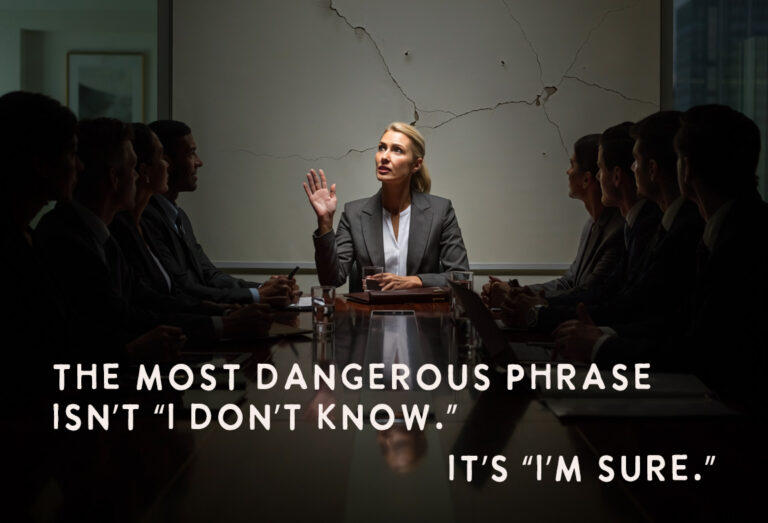


Leaders don’t have a decision problem. They have a decision process problem.
Right now, most executives are being challenged to decide faster and with less certainty than they are used to. Market shifts, investor pressure, and geopolitical noise all compress timelines. Speed becomes the priority. But speed without structure creates inconsistency. Over time, that shows up in the places that matter in every organization: performance, talent, and trust.
Most executives have decades of experience to drawn on. They know how to read a situation. They’ve seen enough to recognize patterns and assess risk quickly.
The challenge is that the environment no longer behaves like the one those instincts were built in.
Decisions today are rarely clean or linear. They happen where economic volatility, shifting stakeholder expectations, rapid technology change, and workforce dynamics converge. The environment no longer behaves how it used to.
What worked before still matters. It’s just no longer enough on its own.
Where Most Leadership Teams get Stuck
In uncertain environments, leaders default to what they trust most: experience.
That makes sense. Experience creates speed. It helps you recognize patterns and move quickly when something feels familiar.
The problem is that in volatile conditions, things look familiar when they aren’t.
That’s where even strong leaders get into trouble and fall into decision traps. Not because they lack judgment, but because they rely on it too quickly.
Decisions may get made faster, but not better. And trust quickly erodes because teams sense inconsistency or lack of confidence in direction.
What’s missing isn’t more data. It’s discipline.
A Better Way to Decide
The leaders navigating this well are doing something different. They’re not relying on instinct alone. They’re building a more deliberate way of making decisions – one that integrates three elements that most organizations keep separate:
– Experience
– Analytical Capability (including AI)
– Emotional Intelligence
This is Decision Intelligence, a discipline that creates a repeatable process to consistently produce better outcomes under pressure. In this environment how you decide matters just as much as what you decide.
Experience Still Matters, But it has Blind Spots
Experience gives you an advantage. It helps you most quickly when situations are clear. But when environments shift, experience could become a liability. The strongest leaders don’t discard their hard-earned experience. They treat it as a starting point for inquiry, not a speedway to conclusions.
The strongest leaders treat experience as a starting point for inquiry, not a speedway to conclusions.
“What’s the same here? What’s actually different? What assumptions am I carrying that may not hold true anymore?”
That pause for situational interrogation is where better decisions start.
AI Extends Judgment – It Doesn’t Replace It
There’s a tendency to think of AI as a substitute for executive thinking. That isn’t accurate. AI is most valuable when it sharpens judgment rather than replaces it.
It challenges assumptions. It surfaces patterns more quickly. It expands the range of scenarios to consider before committing. It suggests strategic pivots when market conditions change.
Used well, AI doesn’t tell you what to do. It forces you to think more rigorously about why you’re doing it. The risk isn’t underusing AI. It’s using it to confirm what you already believe, rather than exploring its validity.
Where Decisions Succeed or Fail
Even when the analysis is right, decisions can fail for different reasons. Confident leadership in uncertain times requires more than technical competence — it demands emotional clarity and cultural intelligence.
This is where EQ becomes a competitive business variable.
Without EQ, you can make a technically sound decision that fails the moment it rolls out to the organization.
Gallup’s research continues to show that managers are the single largest driver of team engagement. And most recent data confirms that when manager engagement drops, team performance follows. That’s an execution issue, not a cultural one. You’re not just making decisions, you’re shaping how those decisions get interpreted and acted on by.
- What gets said and what doesn’t
- What risks people are encouraged to take
- Whether information flows or gets filtered
- Whether your team pushes forward or presses pause
Execution is always human before it is operational
Without that awareness, and without emotional intelligence, you can make a technically sound decision that fails the moment it rolls out to the organization at large.
What Strong Decision Leadership Looks Like
In a more stable environment, a poor decision could be absorbed. There was time to adjust to missteps. That margin is gone.
Decisions are compounding faster as signals of their impact show up sooner.
The cost of getting it wrong isn’t just the decision itself, it’s also everything that follows — missed opportunities, lengthier execution timelines, and swift erosion of trust.
This isn’t a recommendation to slow things down. It’s about bringing discipline to how decisions get made.
The leaders doing this well operate differently:
They separate urgency from importance. Not every fast decision is a good one.
They create space for challenge before alignment. Once alignment happens, dissent disappears.
They define success before evaluating options.
They bring in perspective early, not just to rubberstamp after direction is set.
They pay attention to how decisions will land, not just whether they are correct.
This all requires discipline, especially under pressure.
Build the Process, Improve Outcomes
Most organizations evaluate decisions after the fact based on performance data.
Very few examine how those decisions were made. If you want better outcomes, you have to strengthen the process behind them.
Start by auditing your current decision process. Ask:
- How do we make high-stakes decisions today?
- Where are we most exposed to bias or blind spots?
- Who is consistently invited into the room? Who isn’t?
- Are we optimized for speed, or for quality?
The advantage will belong to leaders who consistently make better decisions at a pace their competitors can’t match.
The answers to those questions will tell you much about future performance, and where your process can be made more sound.
Decision Quality is a Differentiator
The advantage going forward won’t belong to the leaders making the fastest decisions. It will belong to those who consistently make better decisions at a pace their competitors can’t match.
That requires more than experience or data. It requires a system. Decision quality compounds in this environment. So does decision failure.
Your Move
Pick one decision type that matters most to your organization, like capital allocation, market expansion, or talent hiring. Look at how it’s currently made. Then ask:
Where are we relying too heavily on instinct?
Where are we missing perspectives?
How are we underestimating the human side of execution?
The leaders shaping what comes next aren’t waiting for certainty or better conditions. They’re building stronger decision systems that work in the ones they have now.
Schedule a conversation about upgrading your team’s decision-making approach.
Richard A. Smith is founder of Benton + Bradford Consulting and works with executives navigating complex transitions, economic uncertainty, and strategic inflection points. His approach integrates leadership development, organizational strategy, and the practical application of decision science to help leaders make better choices under pressure.