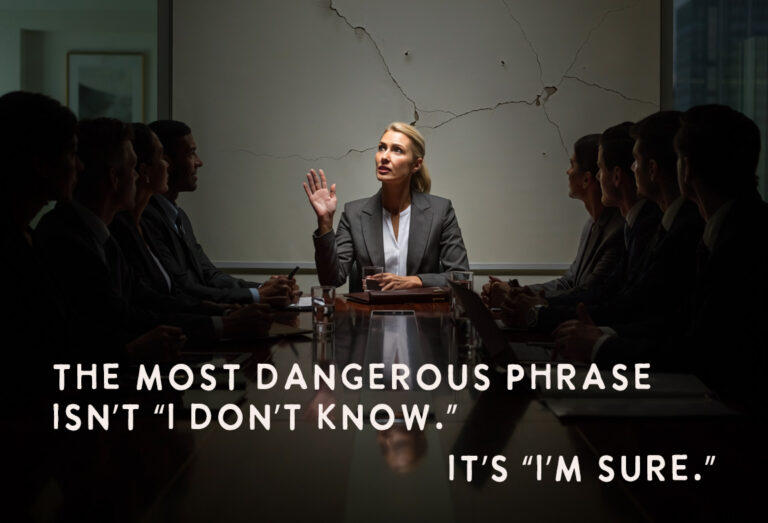


Economic uncertainty tests leaders in ways few other circumstances can. Stakes are high when you’re responsible for protecting your people, safeguarding the business, and making choices with less data and market predictability than you’d like.
Under pressure, even the most seasoned executives can fall into subtle decision traps – cognitive and emotional patterns that distort judgment, stall progress, and weaken strategic outcomes. They often don’t feel dangerous in the moment. But over time, they erode trust and chip away at long-term value.
Here are six of the most common decision traps I see leaders fall into during turbulent times, along with recommended strategies for avoiding them.
1. The Action Bias: Doing Something… Anything
When the environment is unstable, taking quick action can feel like progress. “At least we’re doing something,” we tell ourselves. But urgency without strategic clarity leads to hasty layoffs, blanket cost cuts, or chasing trends simply because competitors are.
How to avoid it:
Pause. Breathe. Prioritize. Bring data and diverse perspectives into the conversation before pulling the trigger. Engage your leadership team in scenario planning. Map out best, middle, and worst cases in both the short term and long term so you’re choosing from a range of thought-out responses, not just reacting to fear.
2. Confirmation Bias: Only Hearing What Confirms Your Beliefs
Uncertainty heightens the need for psychological safety. Unfortunately, that often means clinging to the data points and anecdotes that seem to confirm what we already believe, while discounting anything inconvenient. It feels reassuring in the short term. But it’s dangerous in the long term.
How to avoid it:
Build a deliberate culture of constructive challenge. Ask questions like, “What might we be missing here?” Make space for dissent and reward it. Diverse viewpoints don’t just check your assumptions; they sharpen your strategy.
3. Overreliance on Past Playbooks
Past success stories are very appealing, especially when the future looks like a big question mark. But conditions change, markets shift, talent resources may fluctuate, and customer expectations evolve. Yesterday’s can’t-lose approach could be today’s liability.
How to avoid it:
Differentiate timeless principles (like customer-centricity or disciplined capital allocation) from time-bound tactics. Keep asking, “Does this approach still fit the reality we’re in today?” Encourage teams to pilot new ideas on a small scale. Stay open to experimentation, continuous learning, and nimble adapting.
4. Short-Termism: Sacrificing Tomorrow for Today
Under pressure from investors or internal anxiety, leaders sometimes gut investments that drive future growth. This could look like cutting R&D, freezing innovation, underfunding leadership development, and axing planned headcount additions. It buys short-term relief at the cost of long-term health.
How to avoid it:
Reframe resilience as a long game. Communicate a clear vision that balances current constraints with future possibilities. Use your values as guardrails when making tough choices. Ask: “Does this decision move us closer to who we want to be in three years? Or are we just looking three quarters ahead?”
5. Isolation: Going It Alone
Economic stress can trigger a retreat into executive solitude. Leaders pull back, afraid to show vulnerability or overload their teams. But solitary decision-making rarely breeds clarity. It usually deepens blind spots or enables inactivity instead of thoughtful future proofing.
How to avoid it:
Lean on your people. Engage your team as thought partners, not just implementers of set strategy or worker bees. Invite honest dialogue in all directions within the organization – up, down, and across. Transparency in tough times builds resilience, alignment, and trust, turning your organization into a collective problem-solving engine.
6. The Extremes: Wild Optimism or Unchecked Doom
Some leaders waver between ungrounded optimism (“It’ll blow over any day now,”) and worst-case catastrophizing (“We’re doomed!”) Both extremes distort planning, whiplash teams, and erode stakeholder confidence.
How to avoid it:
Lead from a place of measured realism. Ground decisions and communications in data, not emotion. Be candid about uncertainty, while modeling calm, adaptive leadership. When people see you acknowledging challenges without panicking, it steadies the whole system and invites collaborative problem-solving and innovation.
Decision Discipline: Your Edge in Uncertain Times
Periods of uncertainty don’t just test leaders’ strategy, they reveal their mindset. The leaders who navigate them best aren’t simply decisive. They are decision disciplined and design decision-making environments that reduce bias, promote clarity, and empower their teams by
- Slowing down under pressure, using data to drive systematic thinking.
- Widening their field of vision to challenge assumptions and spark new thinking.
- Building systems that catch bias and encourage diverse input.
- Keeping business strategy and organizational values at the fore.
Using these strategies, organizations can learn, adapt, and grow stronger while dealing with ambiguity.
The world will keep changing. The real competitive advantage belongs to leaders who can keep thinking clearly when it matters most, and who equip their teams to do the same.
If you’re reflecting on how to lead differently this season, what decision habits have helped you navigate uncertainty? Where are you noticing traps creeping in? The most successful leaders don’t go it alone.