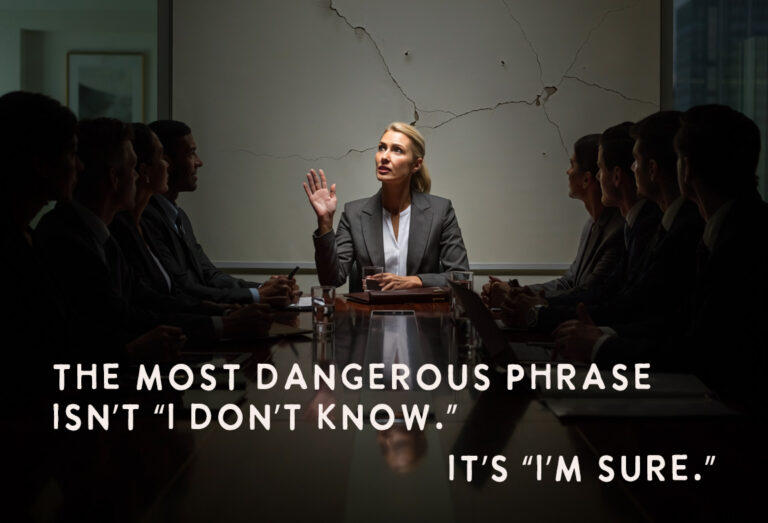


Picture this: You’re in the next quarterly board meeting. Or, you’re speaking at a companywide event. Data shows that revenue is not growing at the same pace year over year. Interest rates are shifting. Customers are hesitating. Meanwhile, a competitor just announced an AI-driven offering that threatens to dominate the industry.
Everyone is looking for your take on the situation.
Do we invest or pull back?
Do we restructure or demand more of our current teams?
Do we wait for further clarity or do we have to make changes now?
In 2026, these are the types of scenarios leaders are facing increasingly. Those who succeed are not necessarily the ones with the longest resumes. They’re the ones who built the right capabilities before pressure peaks.
Here are the seven leadership capabilities that matter most now.
1. Economic Intelligence: Leading Steadily through Shifting Markets
The economic landscape has fundamentally changed and is rapidly changing. It’s currently unsettled in ways we have not seen since the 2008 financial crisis or the early months of the COVID-19 pandemic
Economic intelligence is not about predicting the future or becoming a macroeconomic expert. It’s about developing the discipline to interpret economic signals and translate them into grounded, confident leadership decisions, especially when expectations need to be managed or recalibrated.
Why it matters now
Volatility has become the baseline. Leaders are expected to absorb economic complexity and still make clear calls about growth, pricing, investment, and people. Stakeholders don’t expect certainty, but they do expect coherence and transparency in strategic priorities.
Where leaders get it wrong
They react to headlines instead of data. Or they default to blunt instruments like hiring freezes and across-the-board cuts without distinguishing between short-term relief and long-term capacity damage.
A better approach
Strong leaders use economic intelligence to set realistic ambition. They adjust targets with courage, explain the why, and protect the investments that matter most for future performance. A 2025 CEO Agenda study found that 68% percent of CEOs focus on growth drivers, not just cost-cutting, as the top priority for increasing shareholder value, even during economic uncertainty.
What to Consider
What economic signals are you using to guide decisions? Which ones are you simply reacting to emotionally? Who can I collaborate with to test my perceptions and decisions?
2. Adaptive Decision-Making: Conviction with Fluidity
The data will never be complete. Waiting for certainty is no longer prudent – it’s paralyzing.
Adaptive decision-making is the ability to move forward with conviction while staying open to new information. It’s not indecisiveness; it’s maturity.
Why it matters now
Speed matters. But so does trust. Teams can handle change if they believe leaders are thinking clearly and learning quickly.
Where leaders get it wrong
They either cling to decisions long after assumptions have changed – or pivot so frequently that people lose confidence in any direction at all.
What strong leaders do differently
They name assumptions upfront. They design decisions to be revisited with feedback loops. And they treat course-correction as forward-moving intelligence, not failure.
What to Consider
Which of your current decisions would benefit from an after-action review?
3. AI Fluency: Augmenting Human Intelligence, not Replacing It
You don’t need to understand exactly how AI works. But you do need to understand where it excels, and where human judgment remains essential.
AI fluency is about discernment: knowing enough to ask the right questions, challenging your team’s assumptions, and providing the framework for how and when to use it.
Why it matters now
AI is changing how quickly decisions can be made and how much cognitive load teams carry. With 74% of business leaders making 10x more frequent decisions than just three years ago and becoming paralyzed by overwhelming data volume, AI’s usefulness is clear. Leaders who ignore it fall behind. But using it indiscriminately carries huge risks.
Where leaders get it wrong
They either abdicate thinking to tools or deploy AI without clarity about value, ethics, or downstream impact.
What effective leaders focus on
Discerning leaders use AI to reduce administrative drag, save time on repetitive tasks, build skill development, and counter common decision biases while keeping accountability and judgment firmly human. MIT research found that humans and AI work best together when each play to their strengths: AI can handle data analysis, pattern recognition, and processing speed while humans provide contextual understanding, ethical judgment, and strategic vision.
What to Consider
Where could AI free your team’s capacity for more meaningful work? Can you intentionally redirect that time from administrative burden to focus on strategic impact? How can I develop better prompts and ask better questions to use AI more effectively?
4. Emotional Resilience: The Leadership Thermostat
When uncertainty rises, anxiety spreads. Your job is to regulate it, not to eliminate it.
Emotional resilience is the ability to process stress without letting it distort judgment, negatively impact team interactions, or leak into culture.
Why it matters now
Cognitive bandwidth is one of the scarcest resources in leadership. Stress gobbles it up. Resilient leaders aren’t immune to stress, they’re just expert at processing it.
This year, I had the privilege of meeting Doc Rivers, head coach of the Milwaukee Bucks. In a conversation about performance and longevity, he shared that he meditates every single morning.
Not occasionally. Not when things get tough. Every morning.
Think about what that role entails. Managing multimillion-dollar athletes. Navigating relentless media scrutiny. Making split-second decisions under arena lights with millions watching. And before any of that begins, he sits quietly and meditates not because it’s fashionable, but because it’s functional.
Research consistently shows that practices like meditation strengthen executive function and emotional regulation while reducing reactivity. In leadership terms, that means a greater ability to pause, hold complexity, and make sound decisions when the stakes are high.
Where leaders get it wrong
They confuse resilience with toughness or consider it a personality trait. They suppress emotion, neglect recovery, and slowly erode their own decision quality.
What resilient leaders understand
Practices like sleep, mindfulness, movement, coaching, and peer support are not self-care. They are strategic infrastructure. Grounded, steady leaders have built the internal ability to transmit calm when others feel strain.
What to Consider
What practice are you relying on to stay regulated? Would it still help when pressure increases?
5. Talent Development as Strategic Imperative
When economic pressure mounts, development budgets are often the first to go. And leaders are always surprised when their best people leave shortly after.
Talent development is not a benefit. It’s a strategic lever.
Why it matters now
When work increases and resources tighten, capability becomes a key differentiator.
Where leaders get it wrong
They talk about people as assets but treat development as discretionary. The message lands loudly. A recent study found that 56% of staff would leave their role if they didn’t receive the professional development support they needed. You can’t build capability for 2027 if you lose your best people in 2026.
What courageous leaders do
They protect development investment when it’s hardest, not easiest. And they make growth conversations routine, not episodic. Harvard research found that nearly 5,000 public companies that cut generic costs in recession periods could not flourish once the market recovered. Companies that excel at creating opportunities for employees to build skills consistently achieve top-tier financial performance.
What to Consider
How can I continue to develop my teams’ skills and increase their capabilities when times are tough.
6. Cross-Functional Systems Thinking: Seeing the Whole Board
Most leadership failures aren’t caused by bad intent. They’re caused by narrow lenses.
Systems thinking is the habit of asking how decisions ripple across functions, customers, and time.
Why it matters now
Cost cuts in one area often create hidden costs elsewhere. Speeding up one functional area can overwhelm another related area.
Where leaders get it wrong
They optimize locally and pay globally. Building capability in this area means regularly stepping back from specific expertise to ask how a decision could impact an entire system.
What to Consider
Who should be in the room to pressure-test the second- or third-order effects of your next major decision?
7. Authentic Executive Presence: Credibility Under Pressure
Executive presence isn’t polish. It’s congruency and alignment.
It’s the ability to show up as yourself while commanding trust and respect in high-stakes situations.
Why it matters now
People are more skeptical of performative leadership than ever. They want leaders who are both confident and real.
Where leaders get it wrong
They hide behind jargon or soften conviction to avoid discomfort.
What to Consider
Record your next presentation or important meeting. Watch it and ask: Am I being authentic or putting on a performance for my team? Do I appear transparent and trustworthy?
The choice in front of you
You can wait until these capabilities become urgent requirements – for the market to force your hand, for your board to demand change, or for your team to lose confidence.
Or you can build them now, deliberately, while you still have space to do it well. The leaders who succeed this year will be those who recognized what they needed to strengthen and acted decisively.
If you recognize gaps in more than one of these areas, let’s schedule a short consult to discuss your leadership goals.
And keep reading… Next, I break down what it looks like to build these capabilities in practice.