

Part of my work as an executive coach involves pattern recognition – understanding how leaders make decisions, where their judgment is sharp, and where their blind spots torpedo value.
I look for those patterns everywhere: strategy and operational meetings, talent planning sessions, board meetings, and even reality TV. The Traitors isn’t just prime-time suspense; it’s effectively a lab in which smart people make bad calls when the stakes and social pressures spike. The same mechanics that produce jaw-dropping eliminations on the show cost companies millions: bad hires, misallocated capital, and strategies built on conviction rather than clarity.
The Problem with Being Convincingly Wrong
There’s a moment in nearly every boardroom where the most senior executive in the room makes a compelling case. The logic is sound. Their track record speaks for itself. The conviction is absolute.
Everyone nods.
Here’s what I’ve learned in 25+ years in operational leadership and a decade coaching Fortune 500 executives: the most dangerous decisions aren’t made by people who “go with their gut.” They’re made by highly intelligent executives who’ve built an airtight logical case for something that turns out to be wrong.
Sometimes catastrophically so.
The leaders struggling the most aren’t lacking intelligence or experience. They have both in abundance. What they’re lacking is decision awareness – the ability to see when their intellectual horsepower is working against them, when their seniority gives them conviction that shuts down dissent, when their logic is so convincing it masks a fundamental flaw.
They can’t articulate when their judgment works and when their blind spots betray them.
You’ve seen this. The brilliant strategist who missed the market shift because their analysis of historical patterns was flawless – but the pattern had changed. The operationally excellent CEO who executed an acquisition so cleanly it buried the cultural and market mismatch. The respected board member whose reasoning was so compelling that no one tested its premise until it was too late.
The problem isn’t that these executives are wrong. It’s that they’re wrong in ways they can’t see. Their competence makes their blind spots invisible.
Decision Intelligence: The Missing Capability
Decision intelligence is the capability to make consistently better decisions under uncertainty. It’s not about being right every time. It’s about knowing when your process is reliable and when it needs countermeasures.
Most executives don’t struggle with analysis. They struggle with recognizing when analysis is being distorted by factors they can’t see from inside the decision.
Four Cognitive Errors Executives Make Every Week
These patterns show up in The Traitors and in the C-suite. We see the same mechanics, just different consequences.
Confirmation Bias on Steroids Once you suspect someone, every interaction can confirm that suspicion. Contrary information gets labeled “irrelevant.”
Social Proof Overriding Independent Judgment When a respected voice takes a position, others align. Not because they agree, but because disagreement feels risky. Consensus forms prematurely.
Recency Bias Overriding Track Record Yesterday’s organizational or individual stumble becomes this quarter’s verdict, even when long-run performance is excellent.
Paralysis Masked as Prudence Some executives refuse to commit until they have “enough information,” which may never arrive. Markets punish indecision as much as error.
Habits to Build Decision Awareness:
Set a decision deadline before you start gathering data. Tell your team: “We decide by Friday, regardless of what we know.” This forces you to distinguish between information that’s genuinely decision-critical versus information you’re using to defer accountability.
Premortem the delay itself. Ask: “If waiting costs us the opportunity, what did we lose by not deciding today?” Most executives analyze the risks of acting. Few calculate the opportunity cost of waiting. Make both visible.
Use the 70% rule. Amazon’s leadership principle: decide with 70% of the information you wish you had. If you wait for 90%, you’re too slow. Practice explicitly identifying when you’ve hit 70% and forcing the call. Track which decisions would have improved with more data (rare) versus which ones benefited from speed (common).
Create a “decide or delegate” forcing mechanism. If you can’t commit with the information available, elevate it or push it down. Holding it in limbo signals you’re managing anxiety, not optimizing outcomes. One leader I work with has a standing rule: no strategic decision sits in his inbox longer than 72 hours without being decided, delegated, or killed.
Name your real blocker. When you catch yourself saying “I need more analysis,” finish this sentence: “The information I’m actually waiting for is _____, and it will change my decision by _____.” If you can’t complete it, you’re stalling, not deliberating.
The executives who overcome paralysis aren’t more risk-tolerant. They’ve built systems that make their decision-making process explicit, time-bound, and accountable.
Three Questions That Reveal Your Decision Blind Spots
Before your next major decision, ask yourself:
1. What would have to be true for me to be wrong about this?
If you can’t articulate it, you’re in confirmation bias territory. The most dangerous executives aren’t the ones who make bold calls – they’re the ones who can’t imagine the contrary case.
2. Who has the most to lose if I’m wrong, and have I actually asked them?
The people closest to execution often see risks that leadership misses. Your front-line managers know which “efficiency initiative” will crater morale. Your CFO knows which growth plan will stress the balance sheet. But they’ll hold back if you’ve already signaled the answer you want.
3. If I had to personally live with the five-year consequences, would I decide differently?
Leaders measured on short-term outcomes make different decisions than those accountable for long-term value. That gap needs to be explicit.
These are practical diagnostics, not philosophical exercises.
When “I Just Know” Stops Working
Many successful executives can’t clearly explain their decision process. They “just know.” Over decades, they’ve internalized a pattern-recognition process.
That works brilliantly, until it doesn’t. As environments become more volatile and the margin for error narrows, unexamined intuition becomes flimsy. Leaders who adapt are the ones who are most aware of when their strengths introduce risk.
On The Traitors, the players who last longest aren’t always the most confident or experienced. They’re the ones who stay alert to how their own certainty can mislead them. The same is true in executive roles. The cost of being convincingly wrong on reality TV is elimination; in business, it’s a destroyed market position, a fumbled acquisition, or a mass employee exit.
The cognitive errors I outlined above – confirmation bias, social proof, recency bias, paralysis – are just a few of the decision traps that become more dangerous when uncertainty increases and the margin for error vanishes.
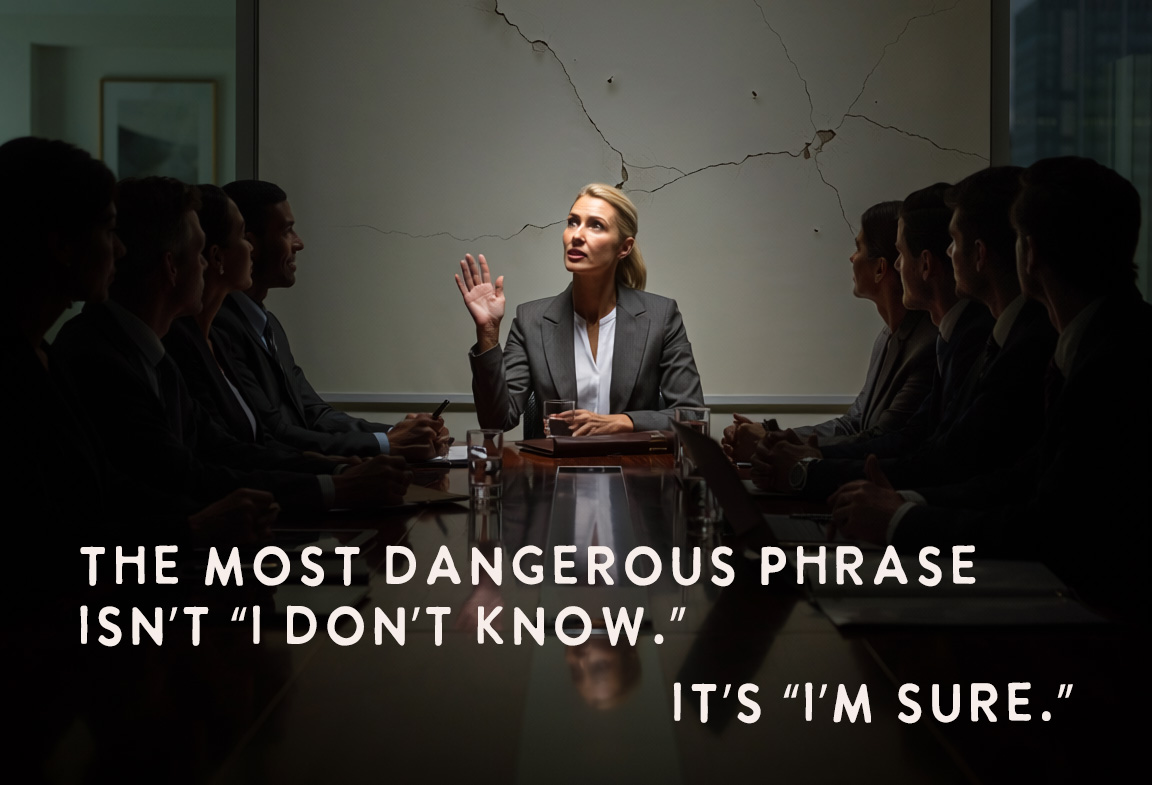
The most dangerous phrase in a boardroom isn’t “I don’t know.”
It’s “I’m sure.”
Final Questions
Think about a major decision you’ve made in the last six months. Can you explain how you arrived at it? Not the outcome – detail the process, including assumptions, inputs, and tradeoffs.
Could you teach the process to someone who will inherit your role?
If not, you’ve uncovered a gap worth addressing.