
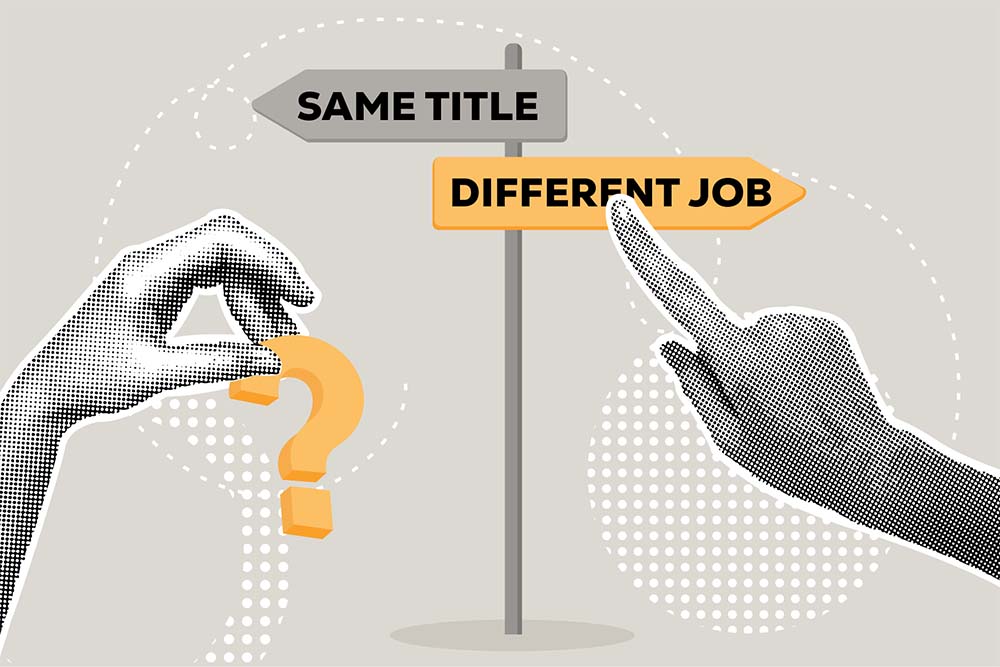

The Role Change No One Announces
The most consequential role change in an organization is usually the one no one announces. While title, reporting lines, and even compensation stay static, the work turns into a different job.
Markets shift. Competitors change the trajectory of the industry. New technologies redefine value. Sometimes the pressure comes from inside instead: growth outpaces the operating model, complexity accumulates, or responsibilities migrate when a leadership seat stays unfilled. Whatever the cause, the expectations attached to a role begin changing long before anyone formally acknowledges that they have.
On paper, nothing has changed. In practice, almost everything has.
At the pace business moves now, this is simply the normal operating environment of the modern organization.
When the Role Outruns the Scorecard
This is where experienced leaders get exposed. A seat once built around execution starts to demand transformation. Deep functional expertise matters less than the ability to influence across teams or lead through ambiguity. Organizations are far slower to redefine a role than to redefine a strategy, so a leader keeps getting measured against an old definition. By the time metrics catch up, a leader could be operating under new assumptions for a year or more.
That gap will not shrink, because the work itself is being rewritten continuously. The World Economic Forum’s 2025 Future of Jobs report finds that 39% of the core skills a job requires are expected to change by 2030. The striking part is what the number describes. It is the same people, in the same roles, doing materially different work over a handful of years. The change happens inside the role, while the org chart shows nothing different.
“39% of the core skills a job requires are expected to change by 2030.”
World Economic Forum, Future of Jobs Report 2025
For a leader, new skills acquisition is the easy part. The harder part is noticing the role has been redefined before the results say it has.
What the Gap Costs
The costs accumulate before anyone names them. Decision rights shift informally while accountability stays put. Work piles up faster than role definitions update. Because the organization keeps functioning, the mismatch reads as normal, and no one investigates it.
This is a different failure than over-certainty, the risk I wrote about in the boardroom, where confidence outruns the evidence. Here the read may be accurate; the trouble is that the situation is no longer the job the leader was hired for.
The common response is almost reflexive: add process through new governance, another layer of review, or a framework to impose order. But process can only encode what already worked. The more novel the environment, the less yesterday’s process protects you, and the more it slows you down while feeling like rigor. When a leader’s first instinct is to build a process when they encounter unfamiliar terrain, that instinct is often the tell that the unfamiliarity has not yet landed.
The Sentence Worth Retiring
Up close, the whole problem often collapses into a single sentence. I am advising a leader whose title has not moved in over a year, while the ground under it has shifted more in six months than in the entire prior decade. The line that keeps surfacing is, “I don’t know what to do.”
I ask them to retire that phrase for two reasons. First, it assumes one person should have the answer. But a genuinely new environment offers certainty to no one, however senior. Second, it is practical. A leader who believes the job is to have the answer stops doing what the moment requires: listening, gathering information, and asking better questions. A leader who projects certainty also trains direct reports and peers to withhold input that could correct a stale read. The admission you work hardest to avoid is often the one that reopens the channel to have helpful, relevant dialogue.
The admission you work hardest to avoid is often the one that reopens the channel to have helpful, relevant dialogue.
Direction is available even when the destination is unclear.
Re-Underwrite the Role
The leaders who adapt fastest do one unglamorous thing: they stop treating their role as fixed. At least once a year, and always after a major business event, they re-underwrite it, the way you would re-underwrite a risk you first priced years ago. The questions are simple:
• What outcomes matter most now?
• Which decisions belong with me that did not before?
• What work should no longer sit here?
• Where is the business asking for influence where it once required control?
• Which capabilities matter more than they did a year ago?
The second half is harder to do alone: get an unfiltered read on how your team actually experiences working with you. The gap between how a leader sees themselves and how the organization experiences them widens fastest in exactly these conditions, when the role is being redefined and everyone is too busy adapting to give candid feedback. That read is the data on whether your team is getting what it needs from you.
Once the misalignment is visible, the work is to reset the role rather than route around it. Make the current reality explicit, backed by evidence rather than impression. Sometimes the job has to be renegotiated and reconfirmed, with a manager, a board, or a peer group. Sometimes it means sharper calls about where your judgment adds the most value now. Either way, the most effective leaders stop defending the old job out of habit. They name the shift, update expectations, and move their attention to the work the business needs today.
Most of the challenges I watch leaders face now have little to do with talent. They come from the gap between what the business now requires and what the organization has actually defined. When it arrives without a promotion or a bigger P&L, the gap sits in the space between the recognized transitions. The title holds while the work moves. That is what makes it the hardest version to see and the easiest to deny. It is no less diagnosable for going unannounced. And it is closeable.
Any senior leader running a business in motion can almost certainly still do their job. But is the job they are doing well still the job the business needs? And would they be the first to know if it were not? The title may stay the same but the business rarely does.
The title may stay the same but the business rarely does.
You may be asking your best people to succeed in jobs the business has already outgrown. To see where that gap sits in your own organization, Schedule a Meeting with Richard Smith
Richard A. Smith is the Founder and Managing Partner of Benton + Bradford Consulting, a leadership advisory firm serving Fortune 500 executives and senior leaders. He brings more than two decades of Fortune 500 operational leadership, including roles at Walmart, Terex, INROADS, and Bell Oaks Executive Search. His advisory work is assessment-led and data-backed: he learns the business first, then diagnoses whether the gap sits in